Why Are AI Companies Rushing to Adopt Agnisys Solutions?

As you may have seen, we publish quite a few blog posts here on the Agnisys site. We cover all kinds of topics, from highly technical details on using our tools to general industry trends. Of course, some posts get more attention than others, and the ones that talk about AI seem to be especially popular right now. In fact, my recent post talking about how AI companies are using our IDesignSpec™ Suite may be our most noticed blog entry in years.
AI Is in the Headlines
Maybe I should say “AI IS the Headline” since it’s such a hot topic these days. From chatbots to robots to semi-autonomous vehicles, AI seems to be on everyone’s mind. Venture capitalists (VCs) are fighting to fund just about any company with an AI-based product idea, with a few significant successes already becoming household names. Not since the dotcom boom has there been so much investment in any one startup sector.
This raises the question of whether AI is hype or reality. People remember when so many dotcom startups flamed out, and wonder if history will repeat itself. Of course, not every company will succeed, but I would argue that there’s more real, powerful technology behind most AI ventures than there was for most dotcom startups. There’s plenty of room for innovation, from algorithms to large language models (LLMs) to generative AI.
The Return of Hardware
During the rush to invest in software and websites, the VC industry fell out of love with hardware. For years, it was almost impossible to get funding to develop new chips. This was due partly to the high cost of deep submicron development and fabrication, and partly to the perception that dotcoms offered a cheaper and easier path to big returns. This trend began to reverse a few years ago as the open RISC-V architecture somewhat reduced the cost of developing new chips.
With AI at the forefront, VCs are rushing to invest in hardware again. Many AI startups are designing their own silicon, with potential rewards that justify the cost of development.
AI Chips Are Massive
Chips for AI applications are some of the largest and most complex in the world. They share many attributes with other large devices such as central processing units (CPUs) and graphics processing units (GPUs), but they have unique requirements as well. For example, they often have an even higher degree of parallelism, and they have extraordinary demands for flexibility. In a recent blog post, I discussed how memory-mapped configuration and status registers (CSRs) play a role.
CSRs are part of the hardware-software interface (HSI), by which low-level software such as drivers and embedded code controls the hardware and collects results. In AI chips, CSRs enable customization of data paths, processing logic, and training parameters as required by adaptable AI models. Building flexibility directly into the hardware provides a level of performance unachievable by any purely software-based solution.
Agnisys Is the CSR Leader
One reason that AI companies are choosing Agnisys is that we are the undisputed leader in the design and verification of CSRs, which are used to hold weights and hyperparameters. From golden executable specifications, our IDesignSpec™ Suite generates the RTL design, testbenches, tests, and documentation needed for all CSRs in the chip. This specification automation flow is straightforward to use and easy to rerun whenever the CSR specifications change over the course of the project.
Many of the CSRs in an AI chip require special attributes, such as read only, write only, locking, and shadowing. IDesignSpec handles all these cases, and also generates the RTL bus interfaces needed to connect the registers to the processors running the HSI code. If any clock domain crossing (CDC) logic or any safety mechanisms are required, those are generated as well. Our solutions easily scale to handle even the largest chip designs.
AI Chips Need More than Registers
Our IDesignSpec Suite also helps with other parts of a complex design, another reason why we have become a popular choice for AI chips. A typical AI design has thousands of blocks, many of them implementing standard functions. Our Silicon IP Portfolio provides bridges, converters, decoders, and crossbar interconnects for a wide range of standard buses. Other features in the IDesignSpec Suite support design of state machines and other design elements.
Last but certainly not least, we stitch together the entire chip hierarchy automatically, generating the top-level RTL as well as any bus bridges, aggregators, and multiplexers needed for the interconnection of standard and custom blocks. All these capabilities are valuable for any large chip, but they seem to resonate especially well with AI designers. I think there’s also one more reason why AI companies are rushing to adopt our solutions…
Agnisys Is the EDA AI Leader
We believe deeply in the power of AI, and we’ve worked very hard to add AI capabilities to our own solution portfolio. Even with widely used standard formats available, many companies still specify their CSRs in a natural language datasheet. So, we created SmartDatasheet to use leading-edge LLM technology to analyze datasheets and extract CSR specifications. This site is available to anyone and serves as an excellent front end to IDesignSpec.
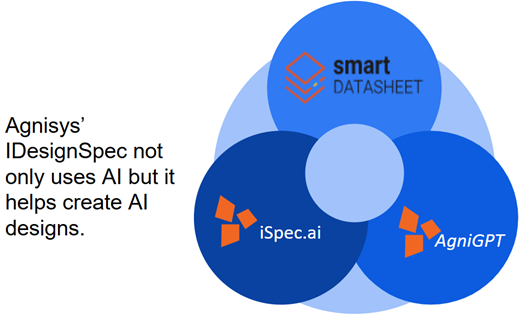
Similarly, we established the iSpec.ai site to translate English statements of design intent into SystemVerilog Assertions (SVA) for inclusion in designs and testbenches. Again, this is available to anyone. We also offer within IDesignSpec the ability to describe CSR programming sequences in English and concert them to SystemVerilog sequences for verification and C/C++ sequences for validation and HSI code. Finally, we offer the AgniGPT chatbot to provide expert guidance to our users.
A Final Word
In thinking about the topic of this post, I realized that there are many reasons for AI chip designers to choose Agnisys as their EDA and IP partner. We support the complexity of AI designs, scale to their massive size, and speak the language of AI. I can promise you that we will add even more AI-based capabilities over time. I invite you to visit our AI solutions page to learn more.


Comments
Post a Comment